
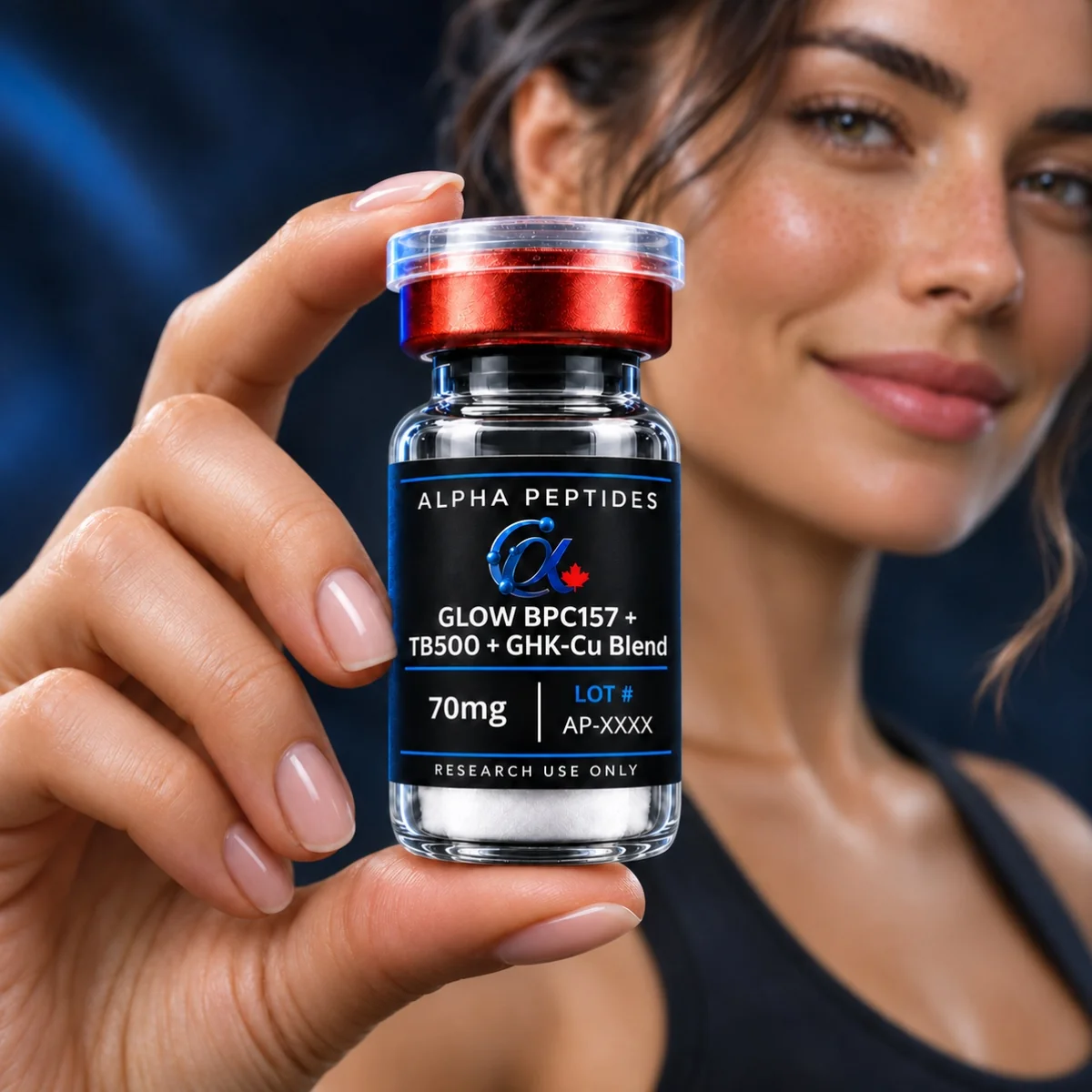
GLOW peptide has become an increasingly discussed combination in the peptide research community, particularly in conversations surrounding skin biology, collagen production, tissue repair mechanisms, and cellular regeneration.
But what exactly is GLOW peptide, what ingredients does it contain, and what does scientific research actually tell us?
In this article, Alpha Peptides Canada explores the compounds commonly associated with the GLOW peptide blend, the research behind its individual ingredients, and the important differences between laboratory findings and established human clinical evidence.
What Is GLOW Peptide?
GLOW peptide is a research blend commonly associated with three peptides:
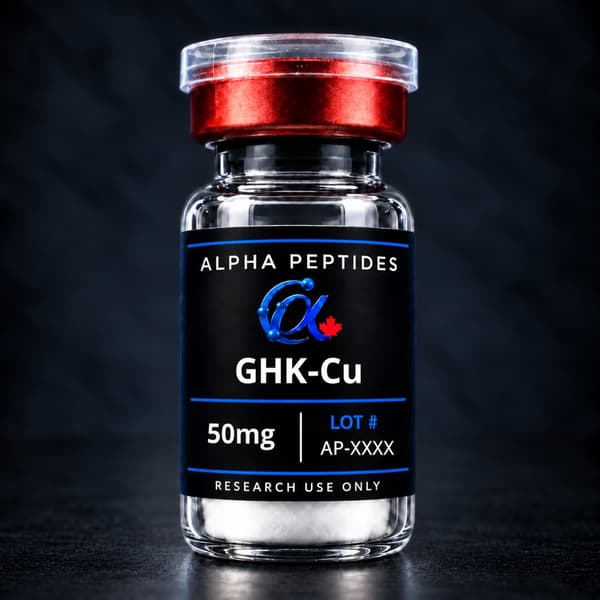
- GHK-Cu (Copper Peptide): Investigated for its involvement in skin biology, extracellular matrix regulation, and collagen-related processes.
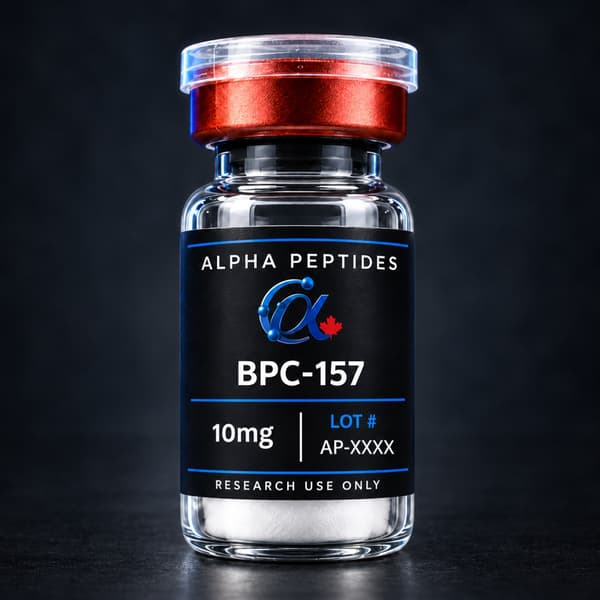
- BPC-157: Studied primarily in preclinical models involving tissue injury, inflammatory pathways, and gastrointestinal biology.
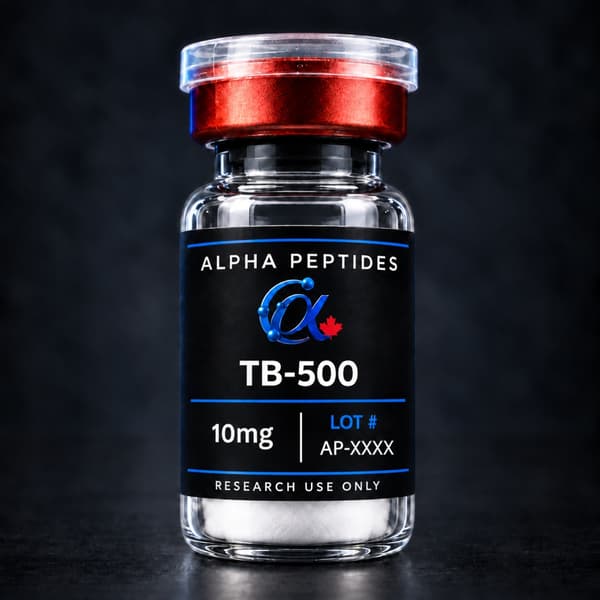
- TB-500: A synthetic peptide associated with thymosin beta-4 research, particularly studies involving cell movement, actin regulation, and tissue repair mechanisms.
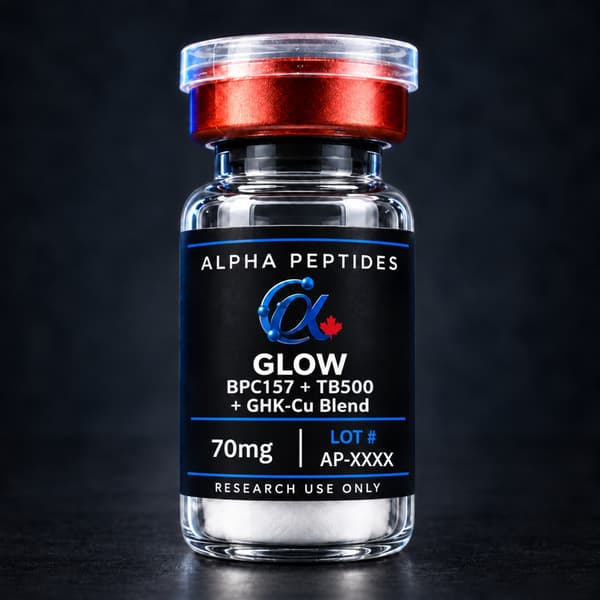
Together, these compounds are marketed under the name GLOW — see the GLOW BPC-157 + TB-500 + GHK-Cu Blend product page for our listed formats, reflecting the blend's association with skin and tissue-related research.
However, GLOW is a commercial blend name rather than a standardized pharmaceutical formulation. Ingredient concentrations and ratios may differ between suppliers.
Importantly, research involving the individual compounds does not establish that combining them produces additional benefits, improved safety, or predictable effects in humans.
GLOW Peptide Ingredients: Understanding the Three Compounds
1. GHK-Cu: The Copper Peptide
GHK-Cu is a naturally occurring copper-binding peptide that has attracted scientific interest because of its involvement in several biological processes.
Research has investigated GHK-Cu in connection with:
- Collagen and extracellular matrix regulation
- Skin cell signaling
- Wound-related biological pathways
- Inflammatory signaling
- Cellular responses associated with skin aging
Some laboratory and preclinical studies have reported changes in biological pathways associated with tissue maintenance and remodeling.
However, these findings should not be interpreted as proof that GHK-Cu injections or GLOW peptide blends improve skin appearance or reverse aging in humans.
Research on topical copper-peptide formulations also cannot automatically be applied to injectable peptide blends.
Related reading: GHK-Cu Explained: What Research Shows About Copper Peptides
2. BPC-157: Research Into Tissue Repair Mechanisms
BPC-157 is a synthetic peptide frequently discussed in experimental tissue-repair research.
Much of the available research involves animal models and laboratory investigations.
Scientists have explored BPC-157 in relation to:
- Experimental tendon and ligament injury models
- Gastrointestinal tissue responses
- Inflammatory signaling pathways
- Blood vessel-related mechanisms
- Cellular responses to tissue injury
Although some preclinical findings have attracted attention, robust human clinical evidence remains limited.
There is currently insufficient high-quality clinical evidence to establish BPC-157 as a safe or effective treatment for injuries, gastrointestinal disorders, or other medical conditions.
Explore: BPC-157 Research Peptide at Alpha Peptides Canada
3. TB-500: Cellular Movement and Tissue Biology
TB-500 is commonly associated with research involving thymosin beta-4, a naturally occurring peptide involved in several cellular processes.
Studies involving thymosin beta-4 have investigated:
- Cell migration
- Actin-related cellular processes
- Experimental tissue repair
- Inflammatory responses
- Angiogenesis-related pathways
An important distinction is that findings involving full-length thymosin beta-4 cannot automatically be attributed to every synthetic peptide marketed as TB-500.
The exact molecular identity and formulation matter when evaluating research findings.
Clinical evidence supporting the safety or effectiveness of TB-500-containing GLOW blends in humans remains insufficient.
Related reading: BPC-157 vs TB-500: Research Comparison and BPC-157 Research Explained
Explore: TB-500 at Alpha Peptides Canada

Why Is GLOW Peptide Associated With Skin Research?
The name GLOW has become associated with skin-focused peptide discussions largely because of GHK-Cu.
GHK-Cu has been investigated for its potential involvement in collagen-related signaling and extracellular matrix regulation, two areas relevant to skin structure.
BPC-157 and TB-500 are more commonly discussed in connection with experimental tissue-repair pathways.
This combination of research interests has contributed to the popularity of GLOW peptide in online scientific and biohacking discussions.
However, biological plausibility is not the same as demonstrated clinical effectiveness.
There is no established body of high-quality human clinical evidence showing that the combined GLOW formulation improves skin appearance, accelerates healing, or produces anti-aging outcomes.
GLOW Peptide Research: What Is Known and Unknown?
When evaluating GLOW peptide research, it is useful to distinguish three levels of evidence.
Laboratory research: Scientists investigate how individual compounds interact with cells, proteins, and signaling pathways under controlled conditions.
Preclinical animal research: Researchers explore biological responses in animal models. These findings can inform future research but do not establish human efficacy.
Human clinical research: Well-designed clinical trials are needed to determine whether a formulation is safe and effective for a specific purpose.
For GLOW peptide, the available scientific discussion relies heavily on studies of individual ingredients rather than research on the combined formulation itself.
Scientific Studies and References
The studies below examine the individual ingredients in GLOW. None of them studied the combined GLOW blend.
1. GHK peptide and skin-related cellular pathways
Pickart L, Vasquez-Soltero JM, Margolina A. (2015). GHK Peptide as a Natural Modulator of Multiple Cellular Pathways in Skin Regeneration. BioMed Research International. Full text.
- What it examined: A review of laboratory, gene-expression and earlier skin studies on GHK and its copper complex (GHK-Cu), including collagen, extracellular matrix and antioxidant pathways.
- Humans or animals: Mostly cell-culture, gene-expression and animal data, plus a small number of topical cosmetic studies in people.
- What it cannot tell us: It does not show that injectable GHK-Cu, or GHK-Cu combined with BPC-157 and TB-500, improves skin in humans. Topical results cannot be applied to other routes or blends.
2. 2026 systematic review of human BPC-157 evidence
Poolton JT, Minett J, Kazmi A. (2026). Human evidence for BPC-157 in orthopaedic and regenerative medicine: a systematic review of efficacy and safety. Acta Orthopaedica Belgica.
- What it examined: Published human data on BPC-157 for musculoskeletal and regenerative uses, including efficacy and safety.
- Humans or animals: Human studies only — and the available human evidence is small, early-stage and of limited quality.
- What it cannot tell us: It does not establish BPC-157 as a safe or effective treatment, and it says nothing about BPC-157 inside a GLOW-style blend.
3. BPC-157, thymosin beta-4 and TB-500 evidence review
Tham A, Hodgkins CW, Kennedy JG. (2026). Investigational Peptides in Orthopaedic Practice: Evidence, Safety, and Patient Counseling for BPC-157, Thymosin Beta-4, and TB-500. Journal of the American Academy of Orthopaedic Surgeons.
- What it examined: A narrative review of the evidence, safety concerns and regulatory status of BPC-157, thymosin beta-4 and products marketed as TB-500 for musculoskeletal recovery.
- Humans or animals: It summarises mostly preclinical (animal and laboratory) research, with limited clinical validation.
- What it cannot tell us: Thymosin beta-4 findings cannot automatically be applied to synthetic TB-500 products, and the review does not support combining these peptides for any human use.
Common Questions About GLOW Peptide
What's the difference between GLOW and KLOW peptide?
GLOW combines BPC-157, TB-500 and GHK-Cu. KLOW contains the same three compounds plus KPV, a short tripeptide studied for its role in inflammatory signalling. Neither blend has been established as safe or effective in human clinical trials.
Is GLOW peptide the same as GHK-Cu?
No. GHK-Cu is a single copper-binding peptide. GLOW is a blend that contains GHK-Cu alongside BPC-157 and TB-500. Research on GHK-Cu on its own cannot be assumed to apply to the full blend.
Is GLOW peptide approved in Canada?
No. We are not aware of any authorization of a GLOW blend, or its individual components, as a drug or natural health product for human use in Canada. Alpha Peptides Canada supplies GLOW for qualified laboratory and analytical research only.
Has the complete GLOW peptide blend been clinically studied?
We are not aware of any published clinical trial testing the complete GLOW blend. The available research — including the studies listed above — looks at GHK-Cu, BPC-157 and thymosin beta-4 / TB-500 individually, mostly in laboratory and animal models.
GLOW at Alpha Peptides Canada
Our GLOW BPC-157 + TB-500 + GHK-Cu Blend combines the three compounds described above and is currently listed in these formats:
- 70mg vial (lyophilized)
- 10 × 70mg vials (10-pack)
- 30mg nasal spray (500mcg per spray)
Every batch is HPLC-tested and supplied with a Certificate of Analysis (COA). For the exact identity, purity and quantities of a specific lot, refer to that batch's COA — see how to read a Certificate of Analysis.
GLOW is supplied for qualified laboratory and analytical research only. It is not intended for human or veterinary use.
Research products in this article
Explore Related Research
- GHK-Cu Explained: What Research Shows About Copper Peptides
- BPC-157 Research Explained
- BPC-157 vs TB-500: Research Comparison
- Shop GLOW peptide in Canada
Disclaimer: This article is provided for educational and scientific information purposes only. It does not constitute medical advice, establish the safety or efficacy of any peptide product, or recommend human or veterinary use of unauthorized substances.
Keep reading
Peptide Guides
GHK-Cu Explained: What Research Shows About Copper Peptides
What does research show about GHK-Cu? Collagen, skin, tissue repair and hair studies, human evidence limits and Canadian regulatory context, explained.
Peptide Guides
BPC-157 Explained: What Research Says About Tissue Repair, Gut Health & Safety
What does research really say about BPC-157? Animal studies, the 2026 human evidence review, safety questions and Health Canada status, explained.
Peptide Guides
BPC-157 vs TB-500: Differences, Benefits & Research
BPC-157 vs TB-500: explore key differences, tissue repair research, mechanisms, safety, and why these peptides are studied together.
Peptide Guides
Best Healing Peptides of 2026: BPC-157, GHK-Cu, TB-500 & CJC-1295 DAC
BPC-157, GHK-Cu, BPC-157 + TB-500 and CJC-1295 DAC compared: mechanisms, the latest 2026 studies, evidence limits and Health Canada warnings.