

GHK-Cu, commonly known as a copper peptide, has attracted growing attention in scientific research for its potential involvement in skin biology, collagen production, tissue remodeling, and cellular signaling.
Unlike many synthetic peptides developed for specific experimental purposes, GHK is a naturally occurring tripeptide found in the human body. Its ability to bind copper ions has made it particularly interesting to researchers studying extracellular matrix biology and tissue repair.
But what does the science actually tell us about GHK-Cu?
Although laboratory studies and animal research have produced interesting findings, the available human clinical evidence remains limited. Understanding the difference between experimental observations and established clinical outcomes is essential when evaluating this compound.
In this article, we examine what GHK-Cu is, how it has been investigated, and what published scientific research currently supports. If you are looking to buy GHK-Cu peptide in Canada for laboratory research, our product page includes current specifications and batch documentation.
What Is GHK-Cu?
GHK-Cu stands for glycyl-L-histidyl-L-lysine copper complex, a naturally occurring copper-binding peptide made up of three amino acids:
- Glycine (G): A simple amino acid involved in numerous biological processes.
- Histidine (H): An amino acid capable of coordinating metal ions, including copper.
- Lysine (K): An essential amino acid involved in protein structure and cellular functions.
Together, these amino acids form the tripeptide GHK.
When GHK binds a copper(II) ion, it forms the complex commonly called GHK-Cu. In cosmetic ingredient terminology, this compound is also known as Copper Tripeptide-1.
The peptide was first identified in human plasma during research conducted by biochemist Loren Pickart in the 1970s.
Since its discovery, researchers have investigated GHK-Cu's interactions with connective tissue, extracellular matrix components, and cellular processes involved in tissue maintenance.
Importantly, GHK and GHK-Cu are not necessarily interchangeable in every experiment. Copper binding can influence chemical properties, biological activity, and formulation behaviour.
Why Are Researchers Interested in Copper Peptides?
Copper is an essential trace element involved in numerous biological processes.
It contributes to the function of certain enzymes associated with connective tissue formation, antioxidant defence, and cellular metabolism.
Researchers are interested in GHK-Cu because the peptide binds copper and may influence biological processes involving cellular signaling and extracellular matrix regulation.
Areas investigated include:
- Collagen synthesis and extracellular matrix remodeling
- Fibroblast activity in laboratory models
- Experimental wound-repair processes
- Oxidative stress and inflammatory signaling
- Hair follicle and skin biology
These research interests do not establish that GHK-Cu produces equivalent benefits in humans.
The strength of the evidence varies significantly depending on the experimental model, formulation, and outcome being measured.
GHK-Cu and Collagen Research
One of the earliest areas of GHK-Cu investigation involves collagen synthesis.
Collagen is an important structural protein found throughout connective tissues, including skin, tendons, and ligaments.
In a 1988 study published in FEBS Letters, researchers investigated the effects of GHK-Cu on fibroblast cultures.
Fibroblasts are cells involved in producing collagen and other components of the extracellular matrix.
The researchers observed increased collagen synthesis in cultured fibroblasts exposed to GHK-Cu under the experimental conditions.
This finding helped establish scientific interest in the peptide's potential involvement in connective tissue biology.
However, the distinction is important:
Increased collagen production in cultured cells does not automatically mean that GHK-Cu improves skin firmness, reverses wrinkles, or repairs damaged tissue in humans.
Cell-culture studies provide evidence of biological activity, but controlled human studies are required to establish clinical benefits.
Read the original collagen research on PubMed.
GHK-Cu and Skin Research
GHK-Cu has also been investigated in dermatological and cosmetic research.
Scientists have explored whether copper peptides influence processes associated with skin structure, extracellular matrix maintenance, and visible skin aging.
These investigations are largely connected to the activity of fibroblasts and the proteins that support skin architecture.
Extracellular Matrix Remodeling
The extracellular matrix is a network of structural proteins and other molecules that helps support surrounding cells.
Research has investigated whether GHK-Cu influences the production and remodeling of extracellular matrix components, including collagen and certain glycosaminoglycans.
A laboratory study published in 1992 reported changes in glycosaminoglycan synthesis in human fibroblast cultures exposed to GHK-Cu.
Another study found that GHK-Cu influenced matrix metalloproteinase-2 and tissue inhibitor activity in cultured fibroblasts, suggesting involvement in matrix remodeling processes.
These observations help explain why copper peptides remain an active topic in skin biology research.
Nevertheless, results from isolated cells cannot be assumed to reproduce the same outcomes in living human skin.
Skin Aging and Cosmetic Research
GHK-Cu has been incorporated into experimental topical formulations and studied for cosmetic outcomes.
Some small human studies have reported encouraging observations, while others have not demonstrated significant improvements on objective measures.
Researchers also continue to investigate how effectively different formulations deliver GHK-Cu through the skin barrier.
A 2026 scientific review emphasized that the available human evidence remains limited and that formulation chemistry can substantially influence how study results should be interpreted.
The existing evidence supports continued investigation, not claims that GHK-Cu is a proven anti-aging treatment.
What Does Research Say About GHK-Cu and Tissue Repair?
Experimental tissue-repair research is another important area of GHK-Cu investigation.
A 1993 study published in the Journal of Clinical Investigation examined the effects of GHK-Cu in an experimental wound model involving rats.
Researchers observed increased accumulation of several connective tissue components within the experimental wound chambers, including collagen and glycosaminoglycans.
These results suggested that GHK-Cu could influence extracellular matrix accumulation under the tested conditions.
Read the animal research study on PubMed.
However, these findings should not be interpreted as proof of therapeutic wound healing in humans.
Animal models can help scientists understand biological mechanisms, but differences in physiology, exposure, and experimental conditions limit direct translation to clinical treatment.
Larger, appropriately controlled human trials remain necessary.
GHK-Cu, Inflammation, and Oxidative Stress
Researchers have also examined GHK-Cu in relation to inflammatory signaling and oxidative stress.
Oxidative stress occurs when reactive molecules and antioxidant defence mechanisms become imbalanced.
Inflammatory signaling is part of the body's response to injury and other biological challenges.
Experimental studies summarized in recent reviews suggest that GHK-Cu may influence certain molecular pathways associated with these processes.
Some investigations have explored changes in gene expression, antioxidant-related activity, and cellular responses under laboratory conditions.
These findings are scientifically interesting, but they do not establish that GHK-Cu treats inflammatory diseases, prevents oxidative damage in humans, or produces measurable clinical improvements.
Further research is needed to determine whether observed molecular effects translate into meaningful outcomes.
GHK-Cu and Hair Research
Another area attracting attention is the investigation of copper peptides in hair and follicle biology.
Researchers have examined whether GHK-Cu-containing topical formulations influence hair-related cosmetic measurements.
A small randomized, double-blind, split-face study published in May 2026 investigated a topical 2% GHK-Cu serum in 18 healthy participants.
After 12 weeks, investigators reported improvements in eyebrow hair count and diameter on the treated side compared with the control side.
Although these findings are noteworthy, the study was small, and the tested topical formulation was not fully characterized in terms of its copper-peptide chemical state.
The results cannot establish that GHK-Cu reliably treats hair loss, and they cannot be generalized to injectable or other formulations.
What Do Human Clinical Studies Actually Show?
Despite decades of laboratory investigation, GHK-Cu's human clinical evidence remains substantially smaller than its preclinical research literature.
Much of the available human research involves topical cosmetic formulations rather than controlled investigations of systemic administration.
A 2026 evidence-mapping review identified several important limitations:
- Human studies generally involve small participant groups.
- Experimental formulations differ between studies.
- Some historical studies lack detailed chemical characterization of the active ingredient.
- Results from topical applications cannot establish the safety or effectiveness of injectable formulations.
- Large, independently replicated trials remain limited.
For example, a small randomized study of a topical copper-tripeptide regimen following CO2 laser resurfacing did not demonstrate a significant objective advantage in the measured outcomes.
By contrast, the small 2026 eyebrow study reported positive cosmetic measurements.
These differing results illustrate why it is necessary to evaluate each study independently rather than presenting all copper-peptide research as evidence of the same benefit.
The current scientific position is that GHK-Cu has demonstrated biological activity in experimental models, while clinical efficacy for therapeutic applications remains unproven.
Read the 2026 scientific evidence review.
Why Peptide Identity, Purity, and Testing Matter in Research
For researchers investigating compounds such as GHK-Cu, the identity and characterization of experimental materials are important considerations.
A study's reproducibility depends partly on whether researchers can establish what compound was tested and whether the material is sufficiently characterized.
Analytical techniques can include:
High-Performance Liquid Chromatography (HPLC): Commonly used to examine chromatographic purity and identify or quantify components under validated analytical conditions.
Mass Spectrometry: Can help investigate molecular identity and confirm whether the detected molecular species are consistent with expectations.
Certificates of Analysis (COAs): May document results of specified analytical tests associated with a particular product batch.
For copper-binding peptides, researchers may also need to consider copper occupancy, chemical stability, and the distinction between intact GHK-Cu, unbound GHK, and free copper.
A reported HPLC purity percentage alone does not establish all these characteristics.
Likewise, analytical purity does not establish that a compound is safe, effective, sterile, or authorized for human use.
Understanding these distinctions is particularly important when evaluating published studies and research materials.
Where Can You Get GHK-Cu Peptide in Canada?
Researchers in Canada looking for GHK-Cu should prioritize suppliers that provide transparent analytical documentation, including HPLC testing results and batch-specific certificates of analysis.
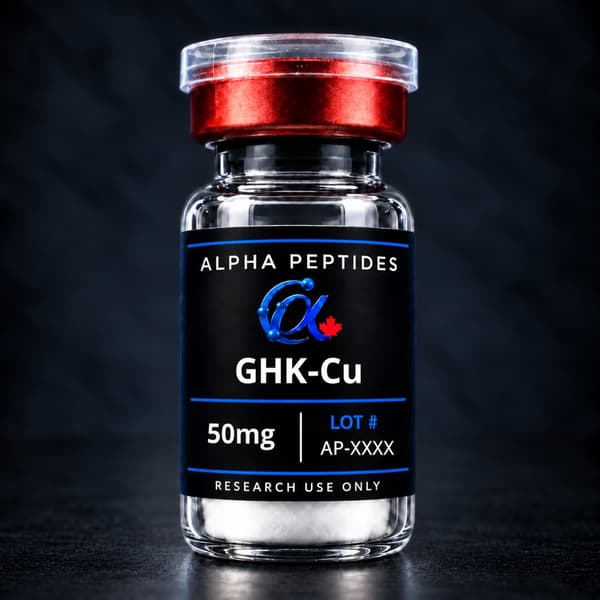
At Alpha Peptides Canada, we supply GHK-Cu as a research peptide for laboratory investigation, with analytical documentation available for each batch. You can buy GHK-Cu peptide in Canada directly from our catalogue, with fast Canada-wide Xpresspost shipping and free shipping on orders over $300.
As with any research material, a certificate of analysis documents selected analytical characteristics of a tested batch; it does not by itself establish safety, clinical efficacy, or regulatory authorization.
Research products in this article
GHK-Cu Research at Alpha Peptides Canada
At Alpha Peptides Canada, we believe scientific research should begin with accurate information, transparent product documentation, and a clear understanding of the limitations of existing evidence.
Our focus is on supplying research peptides for laboratory investigation while encouraging evidence-based discussion of the compounds represented in our catalogue.
GHK-Cu is among the peptides featured in our research product selection.
Researchers exploring this copper-binding tripeptide can visit our dedicated GHK-Cu research peptide product page to review the available product information and specifications.
We emphasize the importance of analytical documentation, including HPLC testing and certificates of analysis, when evaluating research materials.
We also believe it is essential to distinguish promising experimental findings from scientifically established human clinical outcomes.
As research involving copper peptides develops, we aim to provide educational resources that help readers understand the science without overstating what individual studies demonstrate.
Explore our wider research peptide catalogue at Alpha Peptides Canada.
Products described as research peptides are not presented as approved treatments or as intended for human or veterinary administration. Research-use labeling does not itself provide an exemption from applicable Canadian regulatory requirements.
GHK-Cu Safety and Regulatory Considerations in Canada
The regulatory context surrounding copper peptides depends on the product, formulation, intended use, and claims being made.
Cosmetic ingredients and medicinal products are subject to different regulatory requirements.
Health Canada has specifically warned about unauthorized peptide drugs, including products containing GHK-Cu, promoted for human use.
The regulator also cautions that labels such as “Research Use Only” do not automatically make a product lawful to import or sell in Canada.
Potential concerns with unauthorized peptide products include inaccurate labeling, contamination, unverified ingredients, and insufficient evidence of safety.
The presence of GHK as a naturally occurring peptide does not mean that a manufactured GHK-Cu product or a particular administration route is necessarily safe.
Published research on topical cosmetic formulations should not be used as evidence that injectable GHK-Cu is safe or effective.
For additional regulatory information, consult Health Canada's guidance on peptide research and clinical trials.
Frequently Asked Questions About GHK-Cu
What does GHK-Cu stand for?
GHK-Cu stands for glycyl-L-histidyl-L-lysine copper complex. It consists of a tripeptide made from glycine, histidine, and lysine associated with a copper ion.
Is GHK-Cu naturally occurring?
GHK occurs naturally in the human body and can bind copper ions. Manufactured GHK-Cu research materials should not be assumed to have the same characteristics, exposure, or safety profile as naturally occurring biological complexes.
What is GHK-Cu being studied for?
GHK-Cu has been investigated in research involving collagen synthesis, extracellular matrix remodeling, skin biology, experimental tissue repair, inflammatory signaling, and certain cosmetic hair outcomes.
Does GHK-Cu increase collagen?
Some cell-culture studies have observed increased collagen synthesis following GHK-Cu exposure under controlled laboratory conditions. These findings do not establish equivalent clinical improvements in humans.
Is GHK-Cu proven to support hair growth?
No definitive conclusion can be drawn from the current evidence. A small 2026 topical eyebrow study reported encouraging findings, but larger, independently replicated clinical trials are needed.
Is GHK-Cu approved for human use in Canada?
GHK-Cu is not an authorized injectable drug in Canada. Copper Tripeptide-1 may also appear as an ingredient in cosmetic products, which are regulated differently. Product-specific authorization and intended use must be considered separately.
Is a certificate of analysis proof that GHK-Cu is safe?
No. A COA can document selected analytical characteristics of a tested material. It does not by itself establish safety, clinical efficacy, sterility, or regulatory authorization.
Final Thoughts: What Does the Science Say About GHK-Cu?
GHK-Cu remains an interesting compound in peptide research because of its copper-binding properties and the biological activity observed across several experimental models.
Research has investigated its relationship with collagen synthesis, extracellular matrix remodeling, skin biology, and tissue-repair processes.
The preclinical findings provide a foundation for further investigation.
However, laboratory results, animal experiments, and small cosmetic studies should not be interpreted as proof of established therapeutic benefits in humans.
Future research will need to address larger clinical trials, standardized formulations, carefully characterized copper-peptide complexes, and longer-term safety considerations.
At Alpha Peptides Canada, we support informed, evidence-based discussion of peptide science.
To learn more about this compound, explore our GHK-Cu research peptide product information and the wider educational resources available through our website.
Related reading: GLOW Peptide Explained: Ingredients, Research & What the Science Says
Scientific References
-
Maquart FX, et al. (1988). Stimulation of collagen synthesis in fibroblast cultures by the tripeptide-copper complex glycyl-L-histidyl-L-lysine-Cu²⁺. FEBS Letters. PubMed.
-
Maquart FX, et al. (1993). In vivo stimulation of connective tissue accumulation by the tripeptide-copper complex glycyl-L-histidyl-L-lysine-Cu²⁺ in rat experimental wounds. Journal of Clinical Investigation. PubMed.
-
Stimulation of sulfated glycosaminoglycan synthesis by the tripeptide-copper complex GHK-Cu. Life Sciences (1992). PubMed.
-
Bo et al. (2026). The Efficacy of 2% Copper Peptide (GHK-Cu) Serum for Eyebrow Hypotrichosis: A Randomized, Double-Blind, Vehicle-Controlled, Split-Face Comparative Study. Original study.
-
GHK-Cu as a Bioactive Metallopeptide and Drug-Delivery Cargo: Coordination Chemistry, Formulation Science, Therapeutic Evidence, and a Translational Roadmap. Pharmaceutics (2026). Full-text review.
-
Health Canada. Peptides: Research and Clinical Trials. Official guidance.
Disclaimer: This article is provided for educational and scientific information purposes only. It does not constitute medical advice, establish the safety or efficacy of any peptide product, or recommend human or veterinary use of unauthorized substances.
Keep reading
Quality & Testing
How to Read a Peptide Certificate of Analysis (COA)
Learn how to read a peptide COA: HPLC purity, chromatograms, mass spectrometry identity and lot numbers. A guide for Canadian researchers.
Handling & Storage
How to Store Lyophilized Research Peptides
Best practices for storing lyophilized and reconstituted research peptides: temperature, light, moisture and handling tips for Canadian labs.
Peptide Guides
BPC-157 Explained: What Research Says About Tissue Repair, Gut Health & Safety
What does research really say about BPC-157? Animal studies, the 2026 human evidence review, safety questions and Health Canada status, explained.
Peptide Guides
Best Healing Peptides of 2026: BPC-157, GHK-Cu, TB-500 & CJC-1295 DAC
BPC-157, GHK-Cu, BPC-157 + TB-500 and CJC-1295 DAC compared: mechanisms, the latest 2026 studies, evidence limits and Health Canada warnings.