

BPC-157 and TB-500 are two experimental peptides frequently discussed in the fields of tissue repair, cellular regeneration, and regenerative medicine. Although both have attracted scientific interest for their potential involvement in biological repair processes, they differ in molecular structure, proposed mechanisms of action, and the research available to support their effects.
One of the most common questions surrounding these compounds is: What is the difference between BPC-157 and TB-500, and why are they sometimes studied together?
Understanding these differences is important for evaluating the scientific literature, especially because many popular claims about these peptides originate from laboratory experiments and animal studies rather than controlled human clinical trials.
In this guide, Alpha Peptides Canada explores the science behind BPC-157 and TB-500, their individual research profiles, the rationale behind combined formulations, and the limitations of current evidence.
What Is BPC-157?
BPC-157, short for Body Protection Compound-157, is a synthetic peptide consisting of 15 amino acids. Its sequence was developed from research involving a protective protein associated with gastric juice.
BPC-157 has attracted attention in experimental research investigating gastrointestinal tissue, inflammation-related signalling, blood vessel formation, and musculoskeletal repair.
What Does BPC-157 Research Investigate?
Preclinical studies have examined several biological processes:
- Gastrointestinal tissue protection: Animal models have explored how BPC-157 may influence gastric and intestinal tissue responses to injury.
- Tendon and ligament repair: Experimental studies have investigated tissue organization and repair-related outcomes following injury.
- Angiogenesis: Researchers have explored its relationship with signalling pathways involved in new blood vessel formation.
- Inflammatory signalling: Laboratory and animal studies have examined its potential effects on inflammation-associated pathways.
- Cellular repair: Researchers have investigated mechanisms associated with tissue integrity and recovery after experimental injury.
These findings help explain the scientific interest surrounding BPC-157. However, results from laboratory and animal models do not establish that BPC-157 produces equivalent benefits in humans.
Human clinical evidence remains limited, and its long-term safety has not been established.
Read the full guide: What Is BPC-157? explains its research background and evidence limitations.
Related research: Explore our BPC-157 research peptide product information.
What Is TB-500?
TB-500 is a synthetic peptide associated with research on thymosin beta-4, a naturally occurring peptide involved in several cellular processes.
An important scientific distinction is that TB-500 and full-length thymosin beta-4 are not necessarily the same molecule.
Full-length thymosin beta-4 contains 43 amino acids, while TB-500 is commonly identified in scientific literature as a shorter, seven-amino-acid fragment associated with its actin-binding region.
This distinction matters because experimental results involving full-length thymosin beta-4 cannot automatically be attributed to TB-500.
What Does Thymosin Beta-4 Research Investigate?
Studies involving thymosin beta-4 have explored:
- Cell migration: The movement of cells involved in biological repair processes.
- Actin regulation: Cellular mechanisms that influence structure, movement, and organization.
- Wound-related research: Experimental models investigating tissue responses to injury.
- Blood vessel formation: Processes associated with vascular development and tissue remodelling.
- Inflammatory responses: Cellular signalling involved in tissue stress and repair.
Although these areas overlap with some BPC-157 research topics, the underlying molecules and their biological mechanisms differ.
The evidence specifically involving TB-500 is substantially more limited than the broader literature on thymosin beta-4.
Related research: View our TB-500 research peptide product information.
BPC-157 vs. TB-500: What Are the Main Differences?
While both peptides are associated with experimental tissue-repair research, their molecular characteristics and scientific evidence differ.
| Research characteristic | BPC-157 | TB-500 |
|---|---|---|
| Peptide structure | 15 amino acids | Commonly a 7-amino-acid fragment |
| Scientific origin | Synthetic peptide developed from gastric-protein research | Related to thymosin beta-4 |
| Main research interest | Gastrointestinal and musculoskeletal tissue responses | Cell migration and repair-related signalling |
| Proposed mechanisms | Multiple signalling pathways, including angiogenesis-related pathways | Actin-associated cellular mechanisms |
| Preclinical research | Extensive animal research relative to human evidence | Limited direct TB-500 research; larger thymosin beta-4 literature |
| Human clinical evidence | Very limited | No established direct clinical evidence for TB-500 |
| Established human therapeutic benefits | No | No |
| Established long-term human safety | No | No |
Is BPC-157 Better Than TB-500?
Current scientific evidence does not support declaring either peptide superior for human tissue repair, injury recovery, or any other therapeutic purpose.
Although researchers have investigated different biological pathways associated with these compounds, there are no adequate head-to-head human clinical trials establishing which peptide is more effective.
Claims that one is better for tendons while the other is better for muscles should therefore be interpreted cautiously. Such distinctions are frequently based on preliminary biological hypotheses rather than validated clinical outcomes.
Why Are BPC-157 and TB-500 Studied Together?
The combination of BPC-157 and TB-500 has gained attention because research associated with each peptide involves different aspects of cellular and tissue biology.
BPC-157 research has explored pathways related to gastrointestinal protection, tissue responses, and vascular signalling.
Meanwhile, research involving thymosin beta-4 has investigated cell migration, cytoskeletal regulation, and other processes involved in tissue organization.
These distinct research interests provide a theoretical rationale for investigating whether the compounds interact.
However, a theoretical rationale does not establish that combining BPC-157 and TB-500 produces greater effects than studying either compound independently.
Does Combining BPC-157 and TB-500 Create Synergy?
Synergy occurs when the combined effect of two substances exceeds what would be expected from their individual effects.
Demonstrating synergy requires appropriately designed experiments that compare the individual compounds with their combination under controlled conditions.
At present, robust human clinical evidence establishing synergistic therapeutic benefits from BPC-157 and TB-500 is lacking.
Researchers must also distinguish between findings involving TB-500 itself and those involving full-length thymosin beta-4.
Understanding BPC-157 + TB-500 Research Blends
Research blends combine two or more compounds within a single formulation.
When evaluating a BPC-157 + TB-500 blend for legitimate laboratory research, important considerations include the identity of each peptide, the amount of each component, analytical testing, and the documentation available for the specific batch.
A blend should not be assumed to reproduce the findings of studies examining its individual components.
Related product: Explore the BPC-157 + TB-500 research blend from Alpha Peptides Canada.
Research products in this article
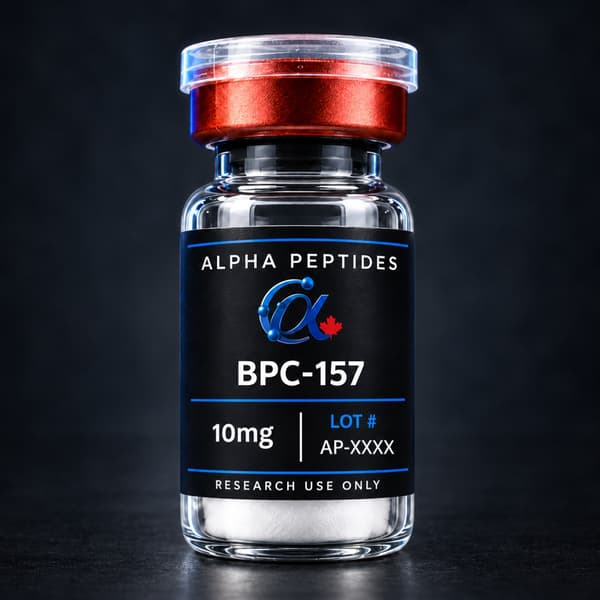
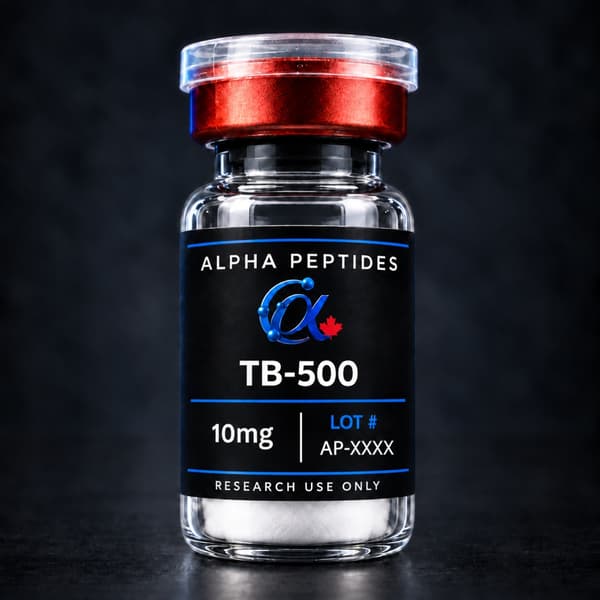
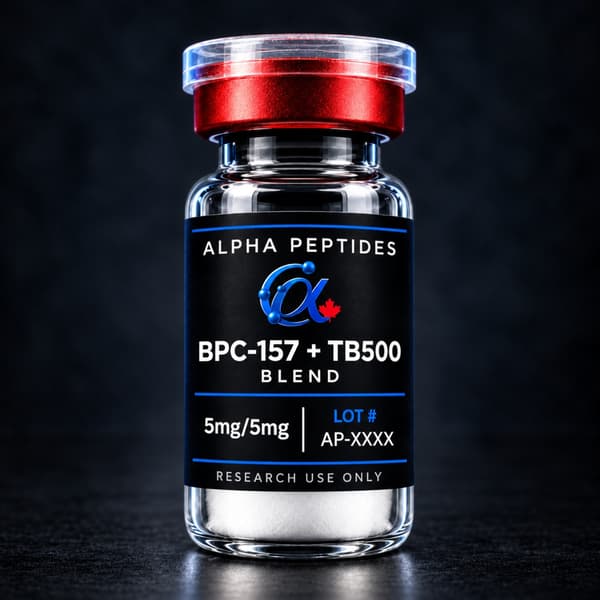
BPC-157 and TB-500 in Tissue Repair Research
Tissue repair involves a complex sequence of biological events, including inflammatory responses, cellular migration, extracellular matrix remodelling, and vascular changes.
These processes are influenced by numerous signalling molecules and cellular pathways.
Experimental peptide research aims to understand whether particular molecules interact with these processes and whether those interactions have meaningful biological effects.
BPC-157 and Tendon Research
Preclinical BPC-157 studies have examined experimental tendon and ligament injury models.
Researchers have investigated outcomes such as tissue organization, cellular responses, and functional measurements in animals.
Although some findings have generated scientific interest, animal results cannot establish that BPC-157 accelerates tendon healing in people.
Controlled human studies are needed to determine whether any observed preclinical effects translate into clinically meaningful outcomes.
TB-500 and Cellular Migration
Much of the scientific discussion surrounding TB-500 comes from research involving thymosin beta-4.
Thymosin beta-4 participates in actin-related cellular processes, which are relevant to cell movement and tissue organization.
Cell migration is important in normal biological repair, but demonstrating an effect on cell migration in an experimental system is not equivalent to demonstrating faster recovery from an injury.
A 2026 scoping review found that the evidence involving thymosin beta-4 and TB-500 was concentrated in laboratory, animal, ocular, and wound-related research. Direct evidence supporting human musculoskeletal applications remained limited.
What About Muscle Recovery?
Both compounds are frequently discussed in connection with exercise recovery and sports-related injuries.
However, there is insufficient high-quality human evidence to establish that either BPC-157 or TB-500 improves muscle recovery, athletic performance, or rehabilitation outcomes.
Research interest should not be confused with demonstrated therapeutic effectiveness.
What Does Human Clinical Research Actually Show?
One of the most important distinctions in peptide research is the difference between preclinical evidence and clinical evidence.
Preclinical research includes laboratory experiments and animal studies. These investigations can help identify potential biological mechanisms and generate hypotheses.
Clinical research evaluates interventions in human participants.
Human Evidence for BPC-157
Published human research involving BPC-157 remains small and methodologically limited.
A 2026 sports-medicine scoping review discussed a retrospective knee-pain study in which some participants received BPC-157 alone and others received combination treatment.
The study reported subjective improvements among some participants, but its limitations included a small sample, mixed medical conditions, the absence of a control group, and limited objective outcome measurements.
These results cannot establish treatment efficacy or long-term safety.
Human Evidence for TB-500
The evidence is even more limited for TB-500.
Some clinical research has examined full-length thymosin beta-4 in specific contexts, including ocular conditions. However, those findings should not be treated as clinical evidence for TB-500.
A 2026 review found that direct TB-500 evidence was sparse and that human musculoskeletal treatment evidence was insufficient.
Has the BPC-157 + TB-500 Combination Been Clinically Proven?
No adequate controlled human clinical trials have established that a BPC-157 + TB-500 blend improves tissue healing or produces superior outcomes compared with either peptide alone.
There is also insufficient evidence to establish the safety of combining these compounds in humans.
Further research would be needed to assess interactions, clinical outcomes, and long-term risks.
Why Peptide Purity and Analytical Testing Matter
In laboratory research, the identity and composition of experimental materials can influence the reliability and reproducibility of findings.
This is particularly relevant when studying synthetic peptides.
What Is HPLC Testing?
High-performance liquid chromatography, commonly abbreviated as HPLC, is an analytical technique used to separate and measure components within a sample.
HPLC can help researchers evaluate peptide purity and identify certain impurities, depending on the testing method.
However, an HPLC purity percentage alone does not establish complete molecular identity, sterility, absence of endotoxins, or suitability for human administration.
Additional analytical methods may be required depending on the research application.
What Is a Certificate of Analysis?
A certificate of analysis, or COA, documents analytical results associated with a specific product or batch.
Depending on the testing performed, a COA may include:
- Product name and batch identification
- Reported peptide purity
- Analytical testing methods
- Chromatographic results
- Molecular identity testing, when performed
- Laboratory and testing information
Researchers should examine which tests were actually conducted rather than assuming that a certificate establishes every aspect of product quality.
Alpha Peptides Canada provides research product information and analytical documentation to help researchers evaluate the materials available in its catalogue.
Understand the report: How to Read a Peptide Certificate of Analysis explains chromatograms, identity testing and batch numbers.
Learn more: Visit our Certificates of Analysis page.
Are BPC-157 and TB-500 Approved in Canada?
BPC-157 and TB-500 are not authorized by Health Canada as approved therapeutic drugs for treating injuries, accelerating recovery, or managing gastrointestinal conditions.
Products labelled for research use should not be interpreted as approved medications.
Both substances also raise anti-doping concerns. The World Anti-Doping Agency prohibits BPC-157 under its non-approved substances category and TB-500 under its growth-factor-related provisions.
Researchers and readers should distinguish scientific investigation from authorized medical treatment.
Frequently Asked Questions About BPC-157 and TB-500
What is the main difference between BPC-157 and TB-500?
BPC-157 is a synthetic 15-amino-acid peptide associated with research on gastric protection and tissue responses. TB-500 is commonly identified as a shorter peptide fragment related to thymosin beta-4, with research interest involving actin-associated cellular processes.
Are BPC-157 and TB-500 the same peptide?
No. They are structurally different compounds associated with different research backgrounds and proposed biological mechanisms.
Why are BPC-157 and TB-500 combined?
The combination is discussed because research associated with the individual compounds involves different cellular pathways. However, controlled human evidence establishing beneficial synergy is lacking.
What is the Wolverine Stack?
The term Wolverine Stack is an informal name commonly used online to describe a combination of BPC-157 and TB-500. It is not a recognized medical treatment, and the name does not establish proven healing benefits.
Can BPC-157 and TB-500 repair tendons or ligaments?
Preclinical studies have investigated repair-related pathways, but there is insufficient high-quality human evidence to establish that either compound repairs tendons or ligaments in people.
Is TB-500 the same as thymosin beta-4?
Not necessarily. TB-500 commonly refers to a synthetic fragment associated with thymosin beta-4, whereas full-length thymosin beta-4 contains 43 amino acids. Scientific findings involving one should not automatically be attributed to the other.
Are BPC-157 and TB-500 safe for human use?
Their safety profiles have not been adequately established through robust human clinical research. Neither should be assumed safe based on animal studies or online reports.
What should researchers look for in peptide documentation?
Important considerations include accurate peptide identification, batch-specific analytical results, clearly identified testing methods, and documentation that distinguishes purity testing from other quality assessments.
Final Thoughts: Understanding BPC-157 vs. TB-500
BPC-157 and TB-500 remain subjects of scientific interest because of their connections to experimental research on cellular signalling, tissue organization, and biological repair mechanisms.
BPC-157 has been investigated in numerous preclinical models involving gastrointestinal and musculoskeletal tissues. TB-500 is associated with research on thymosin beta-4, although direct evidence involving the shorter TB-500 fragment is considerably more limited.
While the two compounds are sometimes discussed together, current evidence does not establish that their combination produces superior therapeutic outcomes or is safe for human use.
For researchers, understanding molecular differences, evaluating the quality of published studies, and reviewing analytical documentation are essential to interpreting peptide research responsibly.
Explore Peptide Research at Alpha Peptides Canada
Alpha Peptides Canada supplies research peptides to Canadian laboratories and qualified researchers, with product information and available analytical documentation.
Explore related research materials:
- BPC-157 Research Peptide
- TB-500 Research Peptide
- BPC-157 + TB-500 Research Blend
- Certificates of Analysis
Research Disclaimer: This article is provided for scientific and educational purposes only. BPC-157 and TB-500 are experimental substances and are not approved by Health Canada or the FDA for human therapeutic use. Alpha Peptides Canada research materials are not intended for human consumption, self-administration, or veterinary use. This article does not provide medical advice.
Scientific References
-
Tewari K. et al. (2026). Peptide Supplements and Their Therapeutic Applications in Sports Medicine. American Journal of Sports Medicine. https://doi.org/10.1177/03635465261464420
-
McGuire F. et al. (2026). Thymosin Beta-4 and TB-500 in Tissue Healing, Regeneration, and Musculoskeletal Repair: A Scoping Review. Applied Sciences, 16(12), 6202. https://doi.org/10.3390/app16126202
-
U.S. Food and Drug Administration (2026). July 23–24, 2026 Pharmacy Compounding Advisory Committee (PCAC) Meeting. Meeting presentation: https://www.fda.gov/media/193773/download
-
World Anti-Doping Agency. 2026 List of Prohibited Substances and Methods. https://www.wada-ama.org/sites/default/files/2025-09/2026list_en_final_clean_september_2025.pdf
Keep reading
Peptide Guides
What Is BPC-157? A Complete Research Guide for Canada
BPC-157 explained: origin, amino acid sequence, what preclinical studies investigate, purity testing and where to buy BPC-157 in Canada.
Quality & Testing
How to Read a Peptide Certificate of Analysis (COA)
Learn how to read a peptide COA: HPLC purity, chromatograms, mass spectrometry identity and lot numbers. A guide for Canadian researchers.
Handling & Storage
How to Store Lyophilized Research Peptides
Best practices for storing lyophilized and reconstituted research peptides: temperature, light, moisture and handling tips for Canadian labs.