
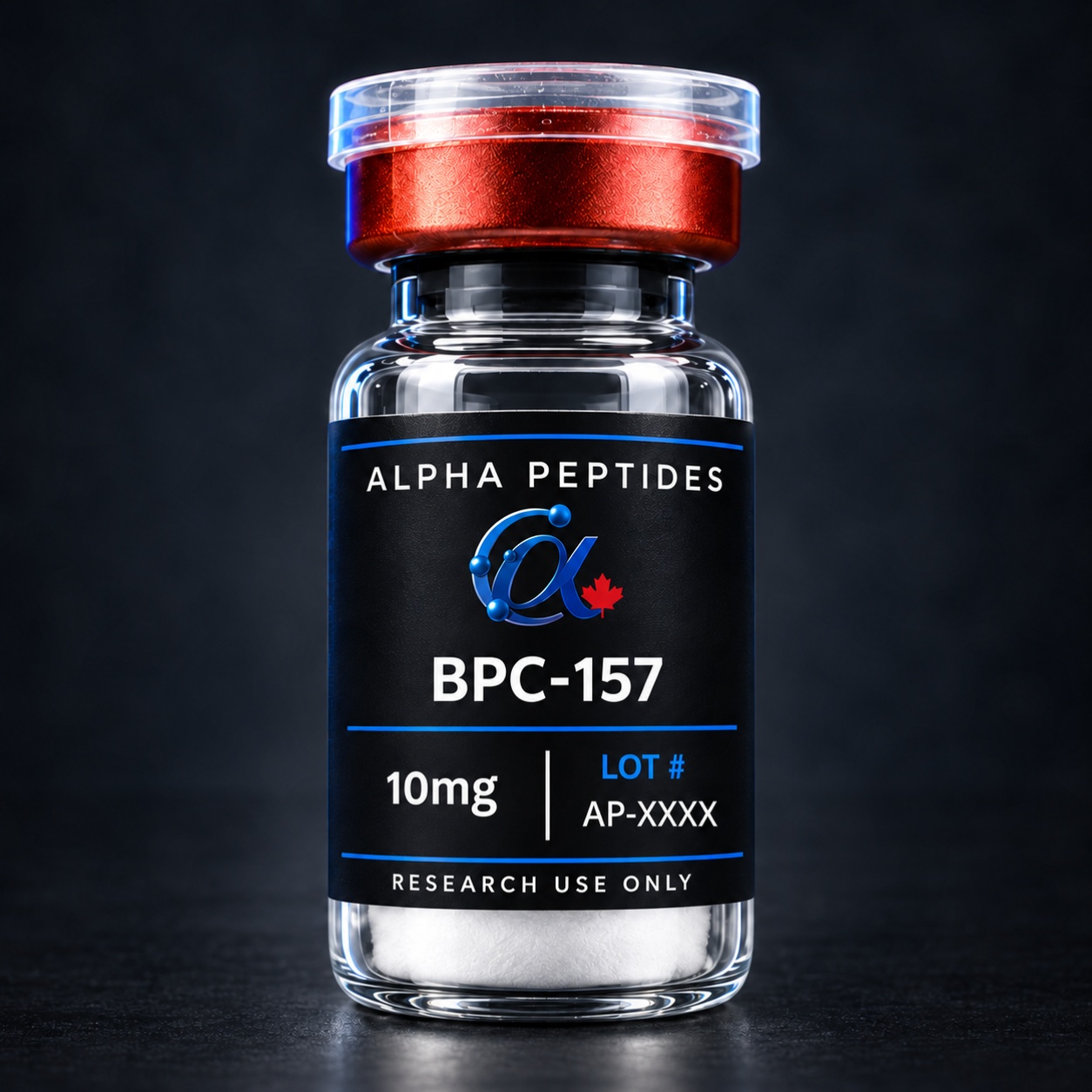
Key takeaways
- BPC-157 is a synthetic 15-amino-acid peptide derived from a sequence found in a gastric protein.
- Most published BPC-157 work is preclinical, using cell and animal models.
- Research areas include tissue repair, tendon and ligament models, and gastrointestinal models.
- Quality depends on verified purity: look for an HPLC chromatogram and mass spectrometry on the COA.
BPC-157 at a glance
BPC-157 (Body Protection Compound-157) is a synthetic pentadecapeptide, meaning a chain of 15 amino acids. Its sequence is derived from a partial sequence of a protein found in gastric juice, which is why it is often described as a "gastric pentadecapeptide" in the scientific literature.
It is supplied as a lyophilized (freeze-dried) powder for laboratory research. In Canada, BPC-157 is not approved by Health Canada for human use and is sold strictly for in-vitro research.
What researchers study BPC-157 for
Published research on BPC-157 is mainly preclinical. Studies in cell cultures and animal models have investigated its role in tissue repair, including tendon, ligament, muscle and gastrointestinal models.
Researchers have also examined how BPC-157 may interact with angiogenesis (new blood vessel formation) and growth factor signalling pathways. These are early-stage findings and have not been established in controlled human clinical trials.
Why purity matters in BPC-157 research
Peptide synthesis can leave truncated sequences, deletion products and other impurities. Impure material can make research results unreliable or impossible to reproduce.
Every Alpha Peptides BPC-157 lot is independently tested by Prism Labs in Canada. The COA includes an HPLC chromatogram showing purity and mass spectrometry confirming that the molecular mass matches BPC-157.
BPC-157 formats and sizes
BPC-157 is most commonly supplied as a lyophilized powder in sealed vials, which keeps it stable during shipping and storage. Researchers reconstitute it with bacteriostatic water before laboratory use.
Many labs also study BPC-157 alongside TB-500, which is why a combined BPC-157 + TB-500 blend is available. Read our BPC-157 vs TB-500 comparison to see how the two peptides differ.
BPC-157 vs TB-500 comparison · BPC-157 + TB-500 blend · Bacteriostatic water
Where to buy BPC-157 in Canada
Alpha Peptides ships research-grade BPC-157 Canada-wide from Ontario via Xpresspost, with free shipping on orders over $300. Every vial ships with a lot-matched Certificate of Analysis from Prism Labs.
Every lot comes with a COA
Independent HPLC chromatograms and mass spectrometry from Prism Labs, Canada's independent peptide testing lab. Match your vial's lot number to its certificate.
Frequently asked questions
What is BPC-157?
BPC-157 is a synthetic 15-amino-acid peptide derived from a sequence found in a gastric protein. It is studied in preclinical tissue repair research.
Is BPC-157 legal in Canada?
BPC-157 can be purchased in Canada for laboratory research. It is not approved by Health Canada for human use or consumption.
Where can I buy BPC-157 in Canada?
Alpha Peptides sells research-grade BPC-157 with Canada-wide Xpresspost shipping and a Prism Labs COA for every lot.
How is BPC-157 purity tested?
Purity is measured by HPLC and identity is confirmed by mass spectrometry. Both results appear on the Certificate of Analysis.
How should BPC-157 be stored?
Store lyophilized vials cold, dry and away from light. Reconstituted solutions should be refrigerated and protected from light.
Is BPC-157 the same as TB-500?
No. They are different peptides with different sequences and research areas. See our BPC-157 vs TB-500 comparison.
Keep reading
Peptide Guides
BPC-157 vs TB-500: Research Comparison and Differences
Compare BPC-157 and TB-500: structure, size, research areas, why labs study them together, and buying tested peptides in Canada.
Quality & Testing
How to Read a Peptide Certificate of Analysis (COA)
Learn how to read a peptide COA: HPLC purity, chromatograms, mass spectrometry identity and lot numbers. A guide for Canadian researchers.
For in-vitro laboratory research only. Not for human or animal use. Not approved by Health Canada for human consumption.